Book Review |
Letters to a
Desperate Stutterer
A Journey
to Fluency
Reviewed By
Bobby G. Bodenhamer, D.Min.
Have you
ever wondered why you speak fluently in some situations and not in
other situations?
How does
my mind-body-behavior system know when to block and stutter and when not to
block and stutter?
Have you
ever asked yourself, “If I did not care what other people thought of me as a
person who stutters (PWS), what would change about my stuttering?”
Consider
this question: “When did I give my power away by allowing other
people to control how I think and feel?”
“Is there
any rational reason for me not to take my power back now and start driving
my own bus rather than living in the back seat at the mercy of somebody else
driving my bus?”
How about
asking yourself, “If I really loved myself in spite of this thing
called stuttering, what would change about my stuttering?”
Or, “What would change about how I speak if I refused from this day forward to fall back into my comfort zone of blocking and stuttering when I feel threatened?”
If you have asked yourself such questions, and I am sure you have, then this book is for you.
(To purchase this book go to: http://bodenhamer.ccfluency.hop.clickbank.net/?tid=M2PBSVSX)
In this magnificent work, you will travel with Linda over a period of a number of years to get to where she is today – fluent in speech. This book is not for those who are unwilling to step out of the box of traditional stuttering treatment. Linda dared to ask questions. And, in daring to ask such questions, Linda quickly found herself out of the box of speech shaping treatments to treating the thinking that triggers blocking and stuttering.
In this expertly written book, Linda Rounds suspends what she had been taught about stuttering as being some mystical malady thought to be primarily a physical problem. Instead, she takes you through her journey of changing her thinking about stuttering and about herself as a PWS and, thereby, gaining complete fluency. And, she teaches you how she changed her thinking and how by doing so, she let go of those fears and anxieties about stuttering that were triggering her to block and stutter.
(Note: By “normal fluency” I (BGB) mean the talk that happens when one is not thinking about how they are talking. The average fluent person just trusts their unconscious mind to provide them with the words they wish to say. The person’s focus is on the other person and maybe the content of what they are saying – not on how they are talking. “Normal fluency” is speech that happens without any fears or anxieties about how one is speaking.
Let this be your outcome for fluency – to remain in a state of calm confidence that you know what you are talking about and that you are worthy of being heard. May your outcome be to speak without thinking about how you are speaking? Some years ago, Linda Rounds told me that she was now 100% fluent in all contexts of her life. She said, “I do not allow the thought of stuttering any place in my mind.” That is a profound statement. May it be your outcome and may it be you?)
Linda’s long path of discoveries about how she discovered fluency is a path of intense struggle; a path of daring to look at oneself critically; a path of venturing where few have traveled. It is this path of self-discovery and the subsequent gaining of normal fluency. In this labor of love, Linda takes the PWS with her on her journey providing practical guidelines as to how she changed her thinking about stuttering.
Her path is a “new path”. Her path runs counter to most accepted methodologies for treating stuttering. As such, Linda will introduce you to new methodologies that addresses those hard questions such as, “How can I be in a conference room speaking fluently with my peers but when my boss walks in, I immediately start stuttering?”
In this seminal work, Linda invites you to travel the “new path” she traveled. Learn how she gradually but persistently challenged old limiting beliefs and values as being irrelevant to her present life and, therefore, open to her changing those meanings to meanings that now serve her as a fluent professional.
To my knowledge, there is not a book written quite like this one. Linda’s work is different in that she provides practical suggestions as to just how she overcame her “stuttering thinking”. She has read extensively and by your reading and studying her book, you will take advantage of years of research by her. In this work, Linda reveals the secrets she has discovered that has helped her to put away her old “stuttering mind” and for her to put on a new mindset resulting in freedom of expression. You will benefit immensely from her studies of Cognitive Psychology, Cognitive Linguistics, Neuro-Linguistics, Neuro-Semantics, Neuro-Science and self-help books written by the best self-help authors such as Tony Robbins.
Unlike many PWS, Linda never let stuttering stand in her way professionally. She is a highly educated Human Resource Professional. I know of other PWS who determined early in life that they were not going to let a stutter stop them professionally. Linda is one of these determined personalities. And, in my opinion, this dogged determination that she has expressed in her professional life has gone a long ways in providing her the drive, the patience, the determination, the resilience, etc. that gaining fluency has required.
As you now begin to read this book, if you do not have such characteristics, then begin now to framing your mind with these thoughts. In all likelihood, you are going to have many failures as you work on your speech under Linda’s tutelage. These are not “failures” so long as you do not allow them to be. They are just setbacks that offer you a learning opportunity. Linda will teach you how to look back on a time of blocking and analyze it as to how it happen and what you need to do to eliminate that kind of thinking.
What is in the book?
To assist you in reading the book, I shall now provide a brief commentary on the contents of each chapter. In reading this summary, you will detect Linda’s passion in transmitting to you the reader what has happen in her life as a direct result of daring to go inside the mind and discover those limiting beliefs that kept her blocking and stuttering for most of her life.
The thread that runs through this work is that in her drive to find the reason that she sometime blocked and why she sometimes didn’t block, her focus moved from blocking and stuttering to what was going on inside. And in almost all of the discoveries that she made she discovered that blocking and stuttering are not the problem. They are the symptoms of a much deeper underlying problem that constantly calls on the PWS to dare to go inside to change those meanings in the mind that do not serve fluency to those meanings that do serve fluency.
Linda discovered something quite fantastic – she discovered that the mind is not made of concrete – those neural circuits are not for the most part unchangeable. Those meanings in our mind are moldable. The mind has plasticity about it. Indeed, the mind is always changing and Linda learned how to change it.
The structure Linda uses is that of answering the questions of a inquiring PWS who is seeking desperately the fluency that Linda has found. Let’s review each chapter.
Keep reading for a brief summary of each chapter in Linda’s book:
Chapter One
Beginning the Journey
Seeing the Obvious in the Medical Studies
Discomfort with People Encounters
What Am I Blocking?
The focus of this chapter is to set the stage for the reader by providing background information about Linda’s struggle with stuttering in an effort to build rapport. She also is attempting to frame the readers mind by letting him know that what she will be discussing may be contrary to his current knowledge and beliefs about stuttering.
Linda builds rapport and begins the process of presenting stuttering using a different paradigm that has been traditionally used by the medical community. Her goal is to immediately present the core issue of stuttering as being more about the fear of people or a communication problem as opposed to a physical problem.
She shares her story by candidly discussing her personal struggles and fears concerning people interactions. The problem she hopes to resolve in chapter one is to help identify what the real issue is behind stuttering. This allows the PWS to begin to focus on the real issues instead of wasting precious time on issues that will never resolve their stuttering such as thinking there is something physically wrong with them.
Throughout the book Linda utilizes her linguistic skills to turn negative “stinking” thinking into positive and “resourceful” thinking. In chapter one she writes:
“Most of us who have spent our lives struggling with stuttering have invested a lot of money in therapy, devices and medication trying to escape the agony of stuttering. The outcome for the majority of us has been dismal and disappointing. The good news is that now you know what will not lead to fluency and can stop wasting your hard earned money on these methods” (Italics mine).
There is no way that I as a non-stutterer can identify with your pain and your struggle. I have heard your stories. I have empathized with your pain as much as I possible could but I have never walked the road you have walked. Linda Rounds knows all about the struggle of being a PWS during childhood, during the teen years and on up into adulthood. She writes:
“When I tell people that I struggled with a stuttering problem for almost four decades, they are in disbelief. During the time I struggled with stuttering I was unable to carry on a fluent conversation. I struggled in most situations including speaking on the phone, one on one conversation, group conversations, reading out loud, and of course public speaking was out of the question. Today I am able to speak fluently in all of these situations and I often present in groups of 200 or more people.”
Linda graciously gives credit to people like John Harrison whose early work entitled How to Conquer your Fears of Public Speaking played a very important role in pointing Linda in the right direction for gaining fluency – John pointed her inside. She without apology challenges the reader to prepare themselves for a journey that involves the opening up of new concepts concerning stuttering. She asks of the reader to “put under the microscope” all of those old beliefs about stuttering that may have been learned.
Her courage jumps out at the reader as she shares how that when she started her journey of healing that she knew no one who had stuttered and who learned how to not stutter. The “professionals” she went to told her that there was no permanent cure for stuttering and that she would have to live with it the remainder of her life.
Her desperation for fluency became so intent that she thought about looking for a surgeon who would remove her voice box. Having her voice box removed would provide a good reason for her not to speak so people would not expect her to speak and she would therefore not be under any pressure to speak thus risking stuttering and the accompanying embarrassment.
While reading a book out loud to herself, for the first time she realized that she was speaking fluently. Though she had done this many times before, for some reason, this time it “hit me like a ton of bricks”. For the first time she realized that in all probability there was absolutely nothing physically wrong with her. Stuttering was all about an inside job. She would speak fluently with a baby or a small child but if an adult walked up, she stuttered. Linda concluded, “I do not have a speech problem; I have a people interaction problem.” She immediately began to approach blocking and stuttering from a totally different perspective – from the inside.
It is here in this first chapter where Linda dives right into the question that each reader must ask themselves, “Who am I as a PWS?” “Am I more than a PWS?” “If I am more than a PWS then who am I?” She explains how she grew up believing she was a “special child” but a child that had to behave as a “special child” in order to be worthy of love. Out of this experience, Linda developed a mental frame that every PWS with whom I have spoken has – a belief that in order to be loved one must be “perfect”. “Perfectionism” finds expression throughout Linda’s journey to fluency. Linda put it this way, “Being good meant being loved.” So, by presupposition, “to be bad (to fail) meant not being loved.” In order to find fluency, Linda had to come to the point where she gave herself permission to fail.
Chapter Two
Uncovering Hidden Truths
A Longing to be Perfect
Why Can’t I Stop Thinking About Stuttering?
Is It Possible to Stop The Obsessive Thoughts?
In Chapter two Linda reveals “hidden truths” that might not be obvious to the person who stutters. These specific “truths” include the PWS propensity to isolate their stuttering problem into a category all its own. The PWS must come to the awareness that stuttering is just a symptom that has a root cause, and that, all humans suffer from the same issues, i.e. fear and anxiety.
Indeed, whenever I provide the technical definition of a “Panic Attack” from the Diagnostic and Statistical Manual of Mental Disorders (Better known as the DSM IV.), the PWS will say, “That is exactly how I feel when I am in a block.”
I certainly do not believe this diagnosis is the result of some accident. It is the result of what people experience, as is the case with blocking. The DSM IV offers this description as to how to diagnose a panic attack:
“A Panic Attack is a discrete period in which there is the sudden onset of intense apprehension, fearfulness, or terror often associated with feelings of impending doom. During these attacks, symptoms such as shortness of breath, palpitations, chest pain or discomfort, choking or smothering sensations and fear of going “crazy” or losing control are present.”
Note the psychosomatic symptoms. Now, move the expression of those emotions to particular areas of the body controlling speaking and you have blocking. The structure is the same; the expressions are different. When a PWS has a block, they are in a panic attack. The fight/flight syndrome has activated as the Amygdala sends a message to the person’s limbs informing them that the system is in danger – prepare to run or remain and fight. Since the PWS has one part that desires so much to speak and another part that is in a panic mode fearful of speaking, these two parts are in conflict and the PWS blocks not knowing what else to do and being totally unable at that moment to speak. It is somewhat like driving down the highway at 100 mph with your breaks on.
You will note that a major portion of the diagnosis of a Panic Attack involves physical symptoms, For the PWS; these “feelings” are usually experienced in the stomach, chest, neck, jaw and/or larynx area. These physical symptoms involve feelings usually of “tightness”, “constriction”, “unable to breathe”, etc.
The PWS eventually stutters through the block. However, she will block again the next time she is in similar circumstances. Why? Because those emotions of fear and anxiety along with all the unconscious negative meanings behind the fear and anxiety are still present and are ready to do their job the next time she is in this same context. They always stand ready because they somehow believe that they are protecting the person. Reframe or heal the emotions of fear and anxiety from the PWS and the physical expression disappears. And, that is exactly what Linda Rounds did and her book tells you how she did it.
In addition, Linda speaks of the other not so apparent truths for the PWS that involve having performance issues, perfection issues and obsessive-stuttering thought issues. As a psychotherapist and one that has worked extensively with PWS over the past six or seven years, I have never worked with a PWS who did not hold the beliefs that they were somehow “less than” and that they had to strive for perfection in order to “be enough” or to “be worthy” enough for someone to love. Linda provides more in depth information about the importance of personal “identity” in Chapter Three.
Linda speaks extensively of the importance of the PWS reframing how they view themselves as an innately worthy person. Indeed, it appears that foundational to blocking are these limiting beliefs about oneself as a person worthy of being loved. The “block” is so often a blocking of one’s “self” because the PWS doesn’t feel that they have anything worthwhile to share. Linda writes:
“If you have the same perfectionist tendencies that I had then you have just identified another symptom. If you identify your symptoms eventually they will lead you to the root issues and you will discover how they are all really tied together. You see, once you discover the root cause of these symptoms and correct the root cause; you will discover a freedom you never imagined.”
Linda’s hope here in Chapter Two is to accomplish the reframing of the PWS thoughts about stuttering by brining to their awareness some of these issues about stuttering covered here. She states, “What I hope the reader will be thinking when they read Chapter Two is ‘Yeah, I do that same thing…now I understand a little more about myself.’”
Linda is candid in revealing her own personal struggles with these same issues. Her motive here is to provide hope that regardless of what the struggles are – there is a way out. And, there is a way out. Linda, along with many others, offers empirical proof that by changing one’s thinking it is indeed possible to overcome the problem of blocking and stuttering. The reader should take this chapter most seriously for herein Linda has revealed the foundational limiting beliefs involved in the triggering of blocking and stuttering. At the end of Chapter Two, Linda shares an extremely important point for every PWS:
“I spent a lot of time reading, researching, and studying the effects of our thoughts on the outcome of our daily lives and came to an undeniable conclusion that I had to stop thinking about stuttering. In fact, after all the research I had done I knew that if I did not stop thinking about stuttering my chances at overcoming the problem were slim to none.” (Bold & italics mine)
Here Linda provides what should be the most important goal for a PWS. And, what is that goal? The goal is to not allow the thoughts about “blocking and/or stuttering” or even “how” you are speaking a place in your mind. Guess what? What would happen to your speech if you never held in mind anything about “how” you are talking and specifically about blocking and stuttering?
Place yourself mentally in a place where you are normally fluent. Do you concern yourself in those situations with the fears and anxieties about stuttering? Do you even think at all about “how” you are talking? Fluent people almost never concern themselves about “how” they are talking. I bet you don’t either when you are in those contexts that you feel safe, comfortable, calm and confident. There is a learning here, isn’t there?
Chapter Three
Stopping the Maddening Thoughts
The Observer Role
Am I My Brain?
In Chapter Three Linda begins focusing the reader’s mind on their beginning to learn how to take control of the way they run their own brain. This chapter focuses on the all important question, “Who are we?” Linda accomplishes this by instilling in the reader that they can do some exciting work on controlling their thought patterns. She leads the reader through the steps that she took to help accomplish the goal. Her desire here is to give the reader some physiological information about how the brain processes information. And, by doing this, they will begin to understand what is happening in their brain when fear is triggered and why it is so difficult to step outside of the fear in those moments.
A great example of Linda’s providing practical tools for one to utilize in controlling their own thought patters, is a model that originated in Gestalt Psychology and later brought into Neuro-Linguistic Programming (NLP) and refined further. This model is about the brain’s ability to mentally “step outside” any thought pattern and to “step into” another thought pattern. It is what Alfred Korzybski in his classic work Science & Sanity spoke about when he spoke of our “learning about learning” as we step outside one state of learning into another state of learning about the first level learning. Utilizing this mental phenomenon, Linda directs the PWS as to “how” to accomplish this using her self as an example.
Einstein spoke about our inability to solve a problem on the level of the problem. We have to go higher and we “go higher” by mentally stepping outside the problem state that we are in where we can analyze the problem and from there we can discover mental resources to bring to the problem and solve it. Now, when you the PWS is “in a block” you are really “in side” of it to the point that it is running your brain and not you. You need the tools to “step out” of that mental state called blocking and to step into a resourceful state so that you can critically analyze the block. After analyzing it, you can discover resource thoughts such as “courage” and bring the resource state to your fears and anxieties thus bringing healing.
A great way to do this is to “step outside” of the negative state so that you mentally “dissociate” from it. Now, there are many different ways to “step outside” of a negative state like blocking, like fear, like anxiety, etc and “step into” other more resourceful states. Here, Linda has chosen one that is simple to do yet powerful in outcome. What do we mean by dissociating? We simply mean to mentally “step outside” – to dissociate from a certain state and when we do that we will associate or “step back into” another state. Here, Linda directs the PWS to “step outside” their stuttering thought processes and to “step inside” a state of observation.
She has an ingenious way of doing this:
“When I was first trying to pay attention to my thoughts I would pretend I was just listening in on myself, like a nosey neighbor would do. It made it more like a game for me and helped me to disassociate from the thoughts a little by becoming an observer instead of an active participant in my own thought process.” (Italics mine)
The remainder of that paragraph contains a very special message to the PWS:
“What is mind boggling to me is that although in the last couple of years I have read a lot of material about the benefits of moving into an “observer” position, at the time I first started monitoring my thoughts I had never heard of the concept of an “observer”. This was just another time that I had been guided, so-to-speak, in doing something that apparently was known by others for a very long time. I implemented it into my journey in overcoming stuttering without realizing that it was a legitimate exercise that psychologist, religious leaders, and a host of others were doing and recommending to their clients.”
The observer position for Linda is a place of non-judgment. It is a place of just observing your own behaviors from a dissociated position that is “outside” the blocking and the stuttering. It is a place of great learning and a place that is absolutely paramount in your learning how to take control of your own thought processes. Linda does an exemplary job in explaining this model.
In addition, in Chapter Three Linda begins provoking some thought on the reader’s part concerning his identity. As most PWS know, they tend to have major identity issues. Linda having experienced such identity issues herself here helps the PWS to begin to see just how valuable they are as a person and that their identity is not based on their brain activity – especially mental activity that leads to the “behavior” called “blocking”.
As I mentioned in the summary of Chapter Two, building a healthy “identity” is extremely important for the PWS in gaining more freedom of expression and ultimately fluency. I love to ask the question, “What would happen if you felt so good about yourself, even though you stutter that you absolutely do not care what others may or may not think of you?” A robust self-image empowers the PWS to not care what other people may think of their stuttering. This is true because this PWS does not measure their sense of self-worth by what others think about them but by what “they” think of themselves. In this book, Linda walks you down a path of her self-discovery of who she really is and this Linda is only concerned about others in the gaining of useful feedback but in no way does she let other people determine who she is. Her identity comes from a much higher source.
In this all important chapter, Linda has shared her story by discussing the struggles she had in trying to run her own brain and what specific things she did to try and bring an end to the obsessive thoughts. She also shares the struggles she had with her own identity. Through her personal stories in this chapter she provides the reader with a deeper understanding of the difference between our brain and our identity.
Ask yourself these questions,
“Who am I that is greater than a person who
stutters?”
“Is my personal self-worth best determined by
someone else or is it determined by me?
“Am I a
human doing or am I a human being?”
“Do I believe that people I know are somehow less than other people just because they may have some un-useful habits?”
Linda leads you through a down to earth self-analysis of just who you are separate from being a person who has a behavior called blocking and stuttering.
Chapter Four
Who Am I?
Understanding the vital role that identity played in her own recovery, Linda now moves to devote a full chapter to the topic. In this chapter Linda attempts to answer the question, “Who am I”. In this chapter Linda begins to reframe the reader’s mind on which he really is. She provides a much more empowering way for the PWS to view themselves in hopes that the readers will begin to move away from the way he currently views himself – which is in every case that I have dealt with most dis-empowering.
Again, Linda here shares her own story by discussing her intimate thoughts about her own identity and the work she did that led her to a new, empowering identity. In this chapter Linda ingeniously moves the PWS from basing their own identity on what they believe other people think of them to deciding themselves who they are. This is absolutely essential for the PWS to gain more fluency.
The PWS must build an empowering identity that basis itself on inner resources rather than on outside mind-reads. I use the term mind-reads because that is exactly what you do when you are overly concerned about the judgments of others. You are mind-reading them and when you mind-read other people as judging you based on your blocking, then you are in fact bringing judgment to bear on them for you do not know what is on their mind. Of great importance is for you to move from identifying yourself based on mind-reading someone else to identifying yourself from within. Linda walks you through just how she accomplished this.
Chapter Five
Renewing My Mind
Drop Down Through
An Unexpected Fear
In This Moment
The focus of chapter five is more technical in nature. This chapter is designed to give the reader an introduction into specific tools he can utilize to “renew his mind” so-to-speak. Linda has provided some tools for changing the stuttering mind-set to a fluency mind-set in previous chapters; in Chapter Five she here begins providing very practical tools for changing perception. After first reading this chapter, I wrote a note about it: “This is an excellent chapter. It is packed with meat.” About this chapter, Linda states, “I shared my story by using personal examples of how I used the tools and what impact they had on my ability to overcome stuttering.” In addition to certain patterns and techniques for change, Linda provides you with the names of some books that had a profound affect on her during her journey to fluency.
Indeed, this chapter is so filled with practical suggestions all provided in the context of Linda’s revealing just how she used them. From her sharing her experience she brings the patterns and techniques from being somewhat abstract to being more specific thus allowing for greater understanding. Many of these tools deal with the structure of how we think. They answer such questions as, “What are you doing inside your head in order to produce blocking?” And, “What would you like to do instead?” More specifically, what are you seeing inside, feeling, hearing and how are you talking to yourself in order to build up such fear and anxiety about blocking?”
Having considered “how” you are structuring anticipatory anxiety now ask yourself the same question but this time with fluency in mind: “When I am fluent, what am I seeing inside my head, what am I hearing, what am I feeling and “how” am I talking to myself?” You will most definitely discover a great deal of differences between the structure of fearing blocking as compared to speaking fluently.
This chapter provides extremely useful information about what Linda utilized in gaining fluency as well as her description of exactly what she did. Here, in Chapter Five, you will learn:
Being open to cognitive therapy
Learning how to interrupt a mental strategy of thinking including the mental strategy that triggers blocking and stuttering
Giving yourself the time necessary to do the work
Learning how to replace old thoughts with new thoughts
Learning how to build in anchors or “triggers” for the triggering of resourceful states
Learning the importance of building new thought patterns through repetitive practice
Understanding the importance of such words as “I have to”, “I must”, “I got to”, and changing them to such words as, “I can”, “I am”, “I will”, “I choose to”, etc.
Learning how to stop anticipatory anxiety (worrying about the future)
Learning the power of the “as if” or the “pretend” frame
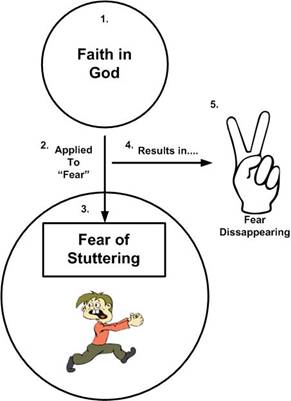
Learning the important structure of bringing a resourceful thought (such as faith) to bear upon a lesser thought such as fear (What happens to “fear” when it is brought into the presence of “faith”? This process is called “Meta-Stating”.)
Learning how Linda utilized meta-stating by merging the picture of a problem state such as “fear” to a resourceful state which in her case was “God” thus eliminating “fear”
How Linda was able to dissociate from fear and anxiety and move herself mentally into the presence of God where she felt safe and secure – another meta-stating process
Learning how to utilize the simple yet extremely powerful tool for healing called “The Drop Down Through” Pattern (Linda provides a transcript of my walking her though this pattern. This pattern is the single most useful pattern that I use in doing therapy.)
Learning the importance of the 5th Perceptual Position and how to utilize that mental position both in healing old negative memories and also how to empower one’s self to live free of fear and anxiety
How Linda defused the “rush of fear”
Learning how to live in the present moment rather than guaranteeing an upcoming block by constantly running a movie in one’s mind of an upcoming feared conversation
Learning how to say “NO!” to negative thoughts like fear, anxiety, low self-esteeming, etc and saying “YES!” to positive thoughts such as security, faith, courage, strength, centered, balanced, etc.
Learning the difference between our perceptual mapping and our external world
Learning that the past is not real; the future is not real; the present is real and even the present is symbolically processed inside our heads with pictures, sounds, feelings and word meanings which are easily distorted.
Understanding that all behaviors have a positive intent for us and that includes blocking and stuttering
Learning how “selfish” blocking and stuttering are
Linda concludes this important chapter with:
“It is a horrible thing to admit but I began to see how self-involved I really was and how this too reinforced stuttering. In truth I wanted to be perfect. I wanted to make an impression on others. I wanted everyone to think that I was smart. I wanted to be respected. I wanted these things so bad because I wanted to be needed by others and that I placed a life and death importance on getting them. The harder I tried to get them the more I stuttered and the more I stuttered the more I felt I did not have them so I tried harder and then I stuttered harder and on and on I went.
“When I realized that this is what I was doing I made an attempt to not only focus on the present moment when I was with others, I also made an attempt to place my focus on the other person(s) need. When I did this I discovered the intensity of blocking and stuttering was reduced. This worked even when I had to give presentations. Instead of focusing on my need not to stutter, I consciously made an effort to identify the needs of my audience. The reason this worked is because it took my focus off of stuttering and on to something else.”
I suggest that the reader spend quite a bit of time in this chapter. Learning these tools usually requires a great deal of practice. I am not speaking of practicing a week or two. Indeed, I suggest that you prepare to practice for several months and maybe even a year or two. For most, stuttering is extremely well learned and re-training the brain not to stutter can be quite a lengthy process. However, the income you receive from this investment in time will in all likelihood prove to be the best investment of your life.
Chapter Six
Beliefs, Values and Perceptions
How Can I Change My Beliefs?
Placing Value on The World Around Me
Is Perception Reality?
In this chapter, Linda focuses on the understanding of what role beliefs, values and perceptions play in the life of PWS. And, by focusing your attention on these mental frames, she hopes to reveal to you the powerful impact that your beliefs, values and perceptions have on how you perceive the world around you. Linda states, “In my opinion, this is the heart of where change can be made for the PWS. Without a close look into these areas and the ability to identify and subsequently change disempowering beliefs, values and perceptions, I am not sure a PWS will ever be able to overcome stuttering.” So, as in the previous chapter, the reader will be well advised to spend quite a bit of time reading and practicing what is in this chapter.
Linda becomes more personal in this chapter as she opens the door of her heart to you, the reader. She invites you to come in and to discover how she struggled with limiting beliefs that “locked her into a block” for most of her life. And, as she shares with you her limiting beliefs, you will immediately identify with her. Over the years of working with PWS and doing a 3 year modeling project on analyzing just how a PWS thinks, I discovered the amazing similarities of thinking that PWS share.
Linda’s is no different. As you read her story, you will read your story and as you read how she changed her limiting beliefs, values and perceptions to empowering ones, know that that can be your story as well – you can change beliefs, values and perceptions. They are not set in concrete. They are the product of a brain that has “plasticity” as a major characteristic.
Know this: “brains change”. You have changed many beliefs and values over the years, haven’t you? Do you still believe a big fat man we call Santa Claus comes down your chimney (You may not even have a chimney.) and leaves presents every December 25? Linda raises the same question. You can change!
Linda begins by sharing with you a major limiting belief that she had which proved to be a key component in holding her back from attaining fluency:
“I once held the belief that to be successful in life I had to respect all authority figures and trust them completely. Compliance to their way of thinking was what I subconsciously believed would make me successful. To a certain degree this is true in the business world but at what cost? For me, it cost me my own self- identity.”
Notice how what seems on the surface to be a productive belief turns out to be a belief that robbed her of her own self-identity. Also take note that this belief of Linda involves the giving of her power away to those people she defined as being in authority over her. The vast majority of PWS would become much more fluent if not completely fluent by simply refusing to give their power to other people.
When we allow our mind-reads of other people’s thinking to control our thinking, we have given our power away. Linda stated, “I was so busy trying to figure out the world from other people’s perspective that I never figured out what the world looked like from my perspective.” I once had a dear friend and a PWS state, “Other people determine my worth as a person.” This is exactly what Linda is writing about. She stopped letting people in authority determine her sense of self-worth. Other people do not control your thinking; you control your thinking. No body can make you think or feel anything without your permission. Linda took control of her mind refusing to let others control her and in the process she gained fluency. Read how she did it and model her actions.
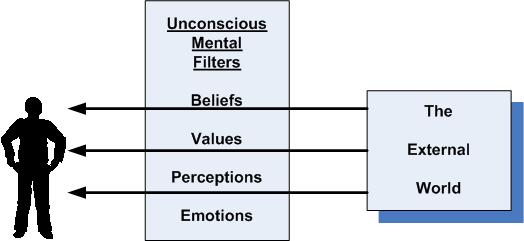
A major theme of this chapter is made up of Linda’s description of how her limiting beliefs, values and perceptions acted as mental filters of incoming information (See Figure F-1). And, obviously, because these filters were not true to fact, they served to give Linda a distorted view of the world. Her belief about authority figures determining her success and her self-worth is an excellent example of erroneous filtering. Put simply, when our filtering system is incorrect, our perceptions are incorrect. As Linda states, “Why are beliefs so powerful? One of the reasons is because our brain does not have the ability to distinguish reality from non-reality.” If you put garbage into your stomach, your stomach will throw it out. If you put garbage in your brain, it will process it as being true for you because you put it in there.
Figure F-1
Unconscious Mental Filters
As you view Figure F-1 take note that what is perceived by the brain is not what is out there. What is perceived by the brain is our internal perception of what is out there filtered by our beliefs, values, perceptions, emotions and other unconscious filters. So, our symbolic (pictures, sounds, feelings, smells, taste, words) perception of what is out there in the world we live in is greatly determine by our mental filters. And, if our filtering system is screwed up, we are screwed up.
Now, consider Linda’s statement, “...once we become aware of our current beliefs, we will be amazed at how many childhood beliefs we are still operating from.” Indeed, almost all of the distorted thinking that I uncover working with PWS is thinking learned in childhood. Indeed, this is true of most all emotional problems faced by adults. Consider this, when you are full of fear and anxiety which leads to your blocking and stuttering, how old do you feel? Most people will say, “Younger” or they will give you an age. It is surprising just how young many of the beliefs that drive most blocking are beliefs birthed in childhood. When the proper trigger is present, the PWS will unconsciously and very rapidly mentally go back and become a little child trying to function in an adult world.
Linda’s story illustrates this to you and you will be able to identify with her discoveries. This identifying with her story will greatly assist you in bringing to the forefront of your mind those limiting beliefs that you have which provided a distorted view of the world issuing in blocking and stuttering plus other unwanted behaviors.
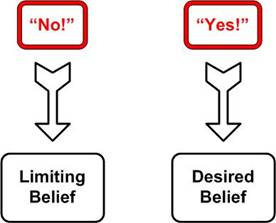
In this chapter Linda provides various tools that she discovered during her journey to fluency that not only assisted her in understanding how distorted her beliefs were but will provide means of changing these beliefs. Remember, since the brain is not made of steel and concrete but malleable neurons and chemicals, you can change it. Here Linda provides some very practical tools in accomplishing positive change. Study and practice what is in this chapter and learn how to effectively say “No!” to disempowering beliefs and “Yes!” to empowering beliefs.
Figure f-2
Changing Beliefs
Linda’s genius really shines here. Close to the end of the chapter, Linda exclaimed:
“Each value and belief that I uncovered, evaluated and changed was one step closer to overcoming stuttering and I noticed improvements in my speech as I went through the process.”
She learned how to apply her higher resources to those limiting beliefs. And, by living out of her higher mind, she eliminated the distortions caused by her limiting beliefs. Her higher mind blew out her limiting beliefs (See Figure F-3 next page).
Figure F-3
Applying “Faith” to Fear
Chapter Seven
The Conclusion of the Matter
In the final Chapter Seven Linda concludes her journey by summarizing for the reader some of the things he can expect to go through in his journey. She stresses that while the journey is definitely do-able it will not be easy and may require a lot of effort and willingness on the PWS part.
Linda shares her story by reiterating how her fear of people and her expectations from other people was at the heart of her stuttering problem. She then concludes by sharing some of the emotions and feelings experienced by her through out the journey. Her purpose is to provide a “heads up” for any one wanting to take the journey.
Linda wants the reader to know that this is not some “quick fix” for stuttering. Indeed, it is far from it. Her journey to fluency involved years of researching, practicing, experimenting, and practicing some more before she found freedom of expression. A belief will fight to survive. Beliefs were formed by you to serve you. They believe they are serving you and that you need them. So, prepare for resistance. You will have it but truth will win if you let it.
I believe that this book will become a major piece of the puzzle being put together in the transformation of the field of stuttering treatment. Linda is proof positive that what is found in this book will work for you if you will work it. We all owe Linda a major debt of gratitude for all the loving sacrifice placed in this volume.
Bobby G. Bodenhamer, D.Min.
www.masteringstuttering.com
bobbybodenhamer@yahoo.com
To purchase Linda’s book go to:
http://www.desperatestutterer.com/
References:
American Psychiatric Association, Diagnostic and Statistical Manual of Mental Disorders (DSM IV), Fourth Edition, American Psychiatric Association, Washington, D.C., 1994.]
Koryzybski, Alfred. (1941/ 1994). Science and sanity: An introduction to non-aristotelian systems and general semantics. (4th Ed & 5th Ed), Lakeville, CN: International Non-Aristotelian Library Publishing Co.]